

As demand for clean hydrogen grows, electrolyser manufacturers are becoming central to industrial decarbonisation and energy system design. These companies develop the systems that split water into hydrogen and oxygen using electricity, but the differences between manufacturers go far beyond this basic function. Technology choice, system scale, and integration capabilities all play a major role in determining performance, cost, and long-term viability.
Understanding how electrolyser manufacturers are differentiated is critical for buyers evaluating hydrogen production systems, particularly as projects move from pilot scale to large industrial deployment.
At a high level, electrolyser manufacturers design and supply the equipment required to produce hydrogen from water. In practice, this involves far more than the electrochemical stack itself. Commercial systems include water purification, power conversion, thermal management, gas separation, and control systems that allow the electrolyser to operate safely and efficiently under varying conditions.
Some manufacturers focus primarily on producing stacks, leaving system integration to engineering firms or project developers. Others provide fully integrated systems, delivering skid-mounted or containerized hydrogen production units that are ready for installation. This distinction is important, as integration complexity can significantly impact both project timelines and performance outcomes.
Most electrolyser manufacturers specialize in one of several core technologies, each with distinct strengths and limitations.
Alkaline electrolysers are the most established and widely deployed systems. They are known for their durability and relatively low upfront cost, which makes them attractive for large-scale, steady-state hydrogen production. However, they are less responsive to fluctuating power input and are not ideally suited for direct coupling with intermittent renewable energy sources.
PEM (Proton Exchange Membrane) electrolysers were developed to address this limitation. They offer fast response times, compact system designs, and the ability to operate dynamically, making them well suited for integration with wind and solar power. The tradeoff is cost, as PEM systems rely on precious metals and more complex materials, which can increase both capital expense and supply chain risk.
AEM (Anion Exchange Membrane) electrolysers are emerging as a hybrid approach that combines elements of both technologies. They are designed to deliver the operational flexibility of PEM systems while using lower-cost materials more similar to alkaline systems. This positions AEM as a promising pathway to reduce system cost without sacrificing performance, particularly in applications where renewable integration and dynamic operation are required.
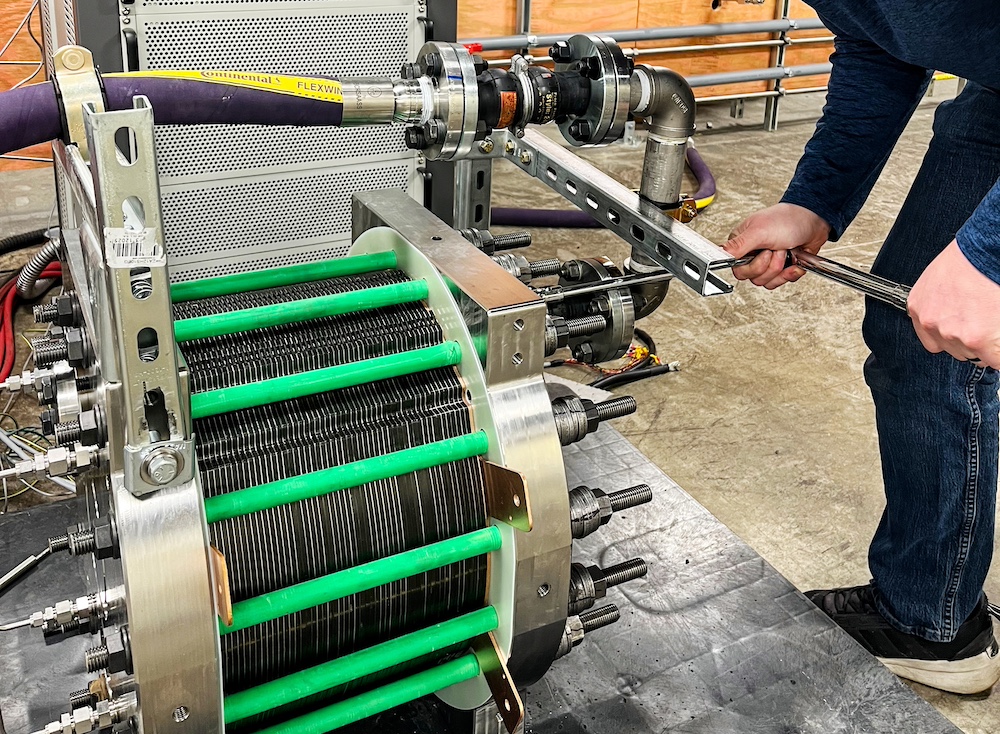
Advancements in AEM technology are increasingly focused on improving durability and scaling systems beyond small modular units. For example, Power to Hydrogen is developing industrial-scale AEM systems and bringing this technology into full commercial deployment, addressing one of the key gaps between emerging innovation and real-world application.
Beyond core technology, electrolyser manufacturers vary significantly in how their systems are designed, produced, and deployed.
One of the most important distinctions is system scale. Some manufacturers specialize in small, modular units suited for pilot projects or distributed hydrogen generation, while others are focused on megawatt-scale systems intended for industrial use. As hydrogen demand grows, the ability to scale systems efficiently is becoming a defining factor in supplier selection.
Manufacturers also differ in their approach to system integration. Companies offering fully integrated solutions typically provide greater reliability and faster deployment, as the system components are designed to work together from the outset. In contrast, projects that rely on multiple vendors may face additional engineering challenges and integration risks.
Performance characteristics such as efficiency, degradation rates, and dynamic operation further differentiate manufacturers. Systems that can respond quickly to changes in power input are increasingly valuable as renewable energy becomes a larger part of the energy mix. At the same time, long-term durability and predictable maintenance requirements are critical for ensuring favorable project economics.

As the hydrogen market expands, manufacturing capability is becoming just as important as technology performance. Electrolyser manufacturers are investing in different production strategies, ranging from standardized, high-volume manufacturing to more customized, project-specific system design.
The ability to scale production capacity, maintain quality control, and secure supply chains for key components all influence a manufacturer’s ability to deliver on large projects. Technologies that rely on scarce or expensive materials may face constraints as demand increases, while systems designed around more abundant materials may offer advantages in long-term scalability.
This is one of the areas where AEM technology is gaining attention. By reducing dependence on precious metals while maintaining strong performance characteristics, AEM systems have the potential to support both cost reduction and manufacturing scale as the market matures.
Selecting an electrolyser manufacturer ultimately depends on how well the system aligns with the intended application. Industrial users with constant hydrogen demand may prioritize durability and cost, while projects tied to renewable energy sources require systems that can operate flexibly under variable conditions.
In many cases, the decision is not about choosing a single “best” technology, but rather identifying the manufacturer whose approach best fits the operational and economic requirements of the project. This includes evaluating not only the electrolyser itself, but also the level of system integration, deployment readiness, and ability to scale over time.
Electrolyser manufacturers are not interchangeable. Differences in technology, system design, and manufacturing approach can have a significant impact on project success. As the market evolves, there is a clear shift toward solutions that can combine low cost, high performance, and scalability.
AEM electrolysis is increasingly positioned within this landscape as a technology that addresses the limitations of both alkaline and PEM systems. As manufacturers continue to bring AEM systems to industrial scale, buyers will have more options that balance performance with cost, helping accelerate the adoption of clean hydrogen across sectors.


