Heavy-Duty Vehicle Hydrogen Refueling: What Project Developers Need to Know
This guide covers the HDV hydrogen refueling station market for project developers evaluating on-site hydrogen production in Europe. It explains the three vehicle segments driving demand, the technology options at 1–5 MW scale, what makes a project fundable, and the key decisions to make before commissioning a feasibility study.
Hydrogen is no longer a future fuel for heavy duty transport. Bus operators, logistics companies, and municipal fleet managers across Europe are actively building refueling infrastructure — or trying to. The policy pressure is real, the fleet demand is forming, and the technology has matured enough to support commercial projects at meaningful scale.
But the gap between "we want to do this" and "we have a commissioned station" remains wide. Most projects that stall do so for the same predictable reasons. Understanding the landscape before you start saves time, budget, and credibility.
Here is what the HDV hydrogen refueling market actually looks like in 2026.
The three heavy-duty vehicle types driving demand for hydrogen refueling
Not all heavy-duty hydrogen applications are the same, and the differences matter for how you size and operate a station.
Bus fleets. Bus fleets are the most established segment. A typical deployment serves 10–20 vehicles from a 1 MW electrolyser producing around 500 kg of hydrogen per day. It is often co-located with a photovoltaic array at the depot. Bus operators value schedule predictability above all else. A station that goes down during morning fueling is not a minor inconvenience.
Long-haul trucks. Long-haul trucks require larger systems. Corridors serving goods transport across central Europe typically involve 2–5 MW installations, with multiple dispensing points and higher daily throughput. The economics are more complex, but the energy density advantage of hydrogen over battery at this range and payload is significant.
Municipal collection vehicles. Municipal collection vehicles are an emerging and fast-growing segment. Cities restricting diesel vehicles from urban centers are pushing waste collection and delivery operators toward zero-emission alternatives. For vehicles running fixed urban routes with predictable return-to-depot patterns, hydrogen is increasingly competitive with battery electric.
What makes a HDV hydrogen refueling station project viable?
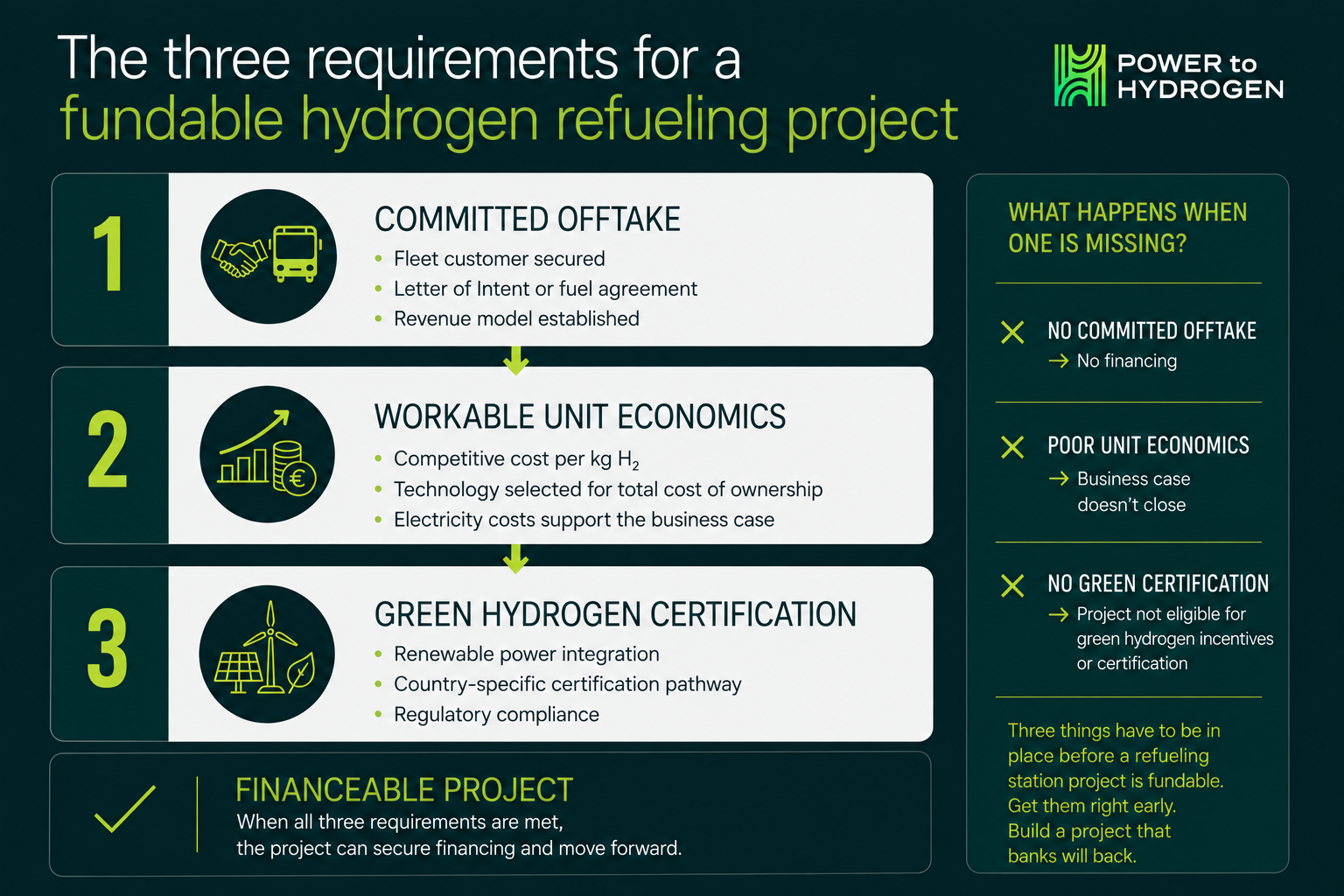
Three things have to be in place before a refueling station project is fundable, and they need to be in place early — not as an afterthought.
Committed offtake. The fleet customer is not just the end user. They are the economic foundation of the project. A station without a committed offtake agreement — or at minimum a serious Letter of Intent — has no revenue model. Without a revenue model, the project cannot be financed. This is the step that project teams most often treat as a downstream concern, and it is the one that most reliably kills projects that were otherwise viable.
Workable unit economics. The cost of producing a kilogram of hydrogen on-site has to be competitive with delivered alternatives and viable relative to what the fleet operator will pay. This comes down almost entirely to technology selection and electricity prices available at the site. Projects built around expensive electrolyser technology often cannot survive contact with a realistic business case. More on this below.
Green hydrogen certification. EU regulations now require that hydrogen count as green only if it is produced from renewable energy at the same time it is consumed. This rules out grid-powered production for most certification pathways and makes on-site renewable pairing — solar or wind connected directly to the electrolyser — a practical requirement, not a nice-to-have. Certification rules are also transposed differently in each member state, which means the specific requirements vary by country and need to be confirmed early in project planning.
The electrolyser at the center of the station is the single variable with the most leverage over whether a project lives or dies.
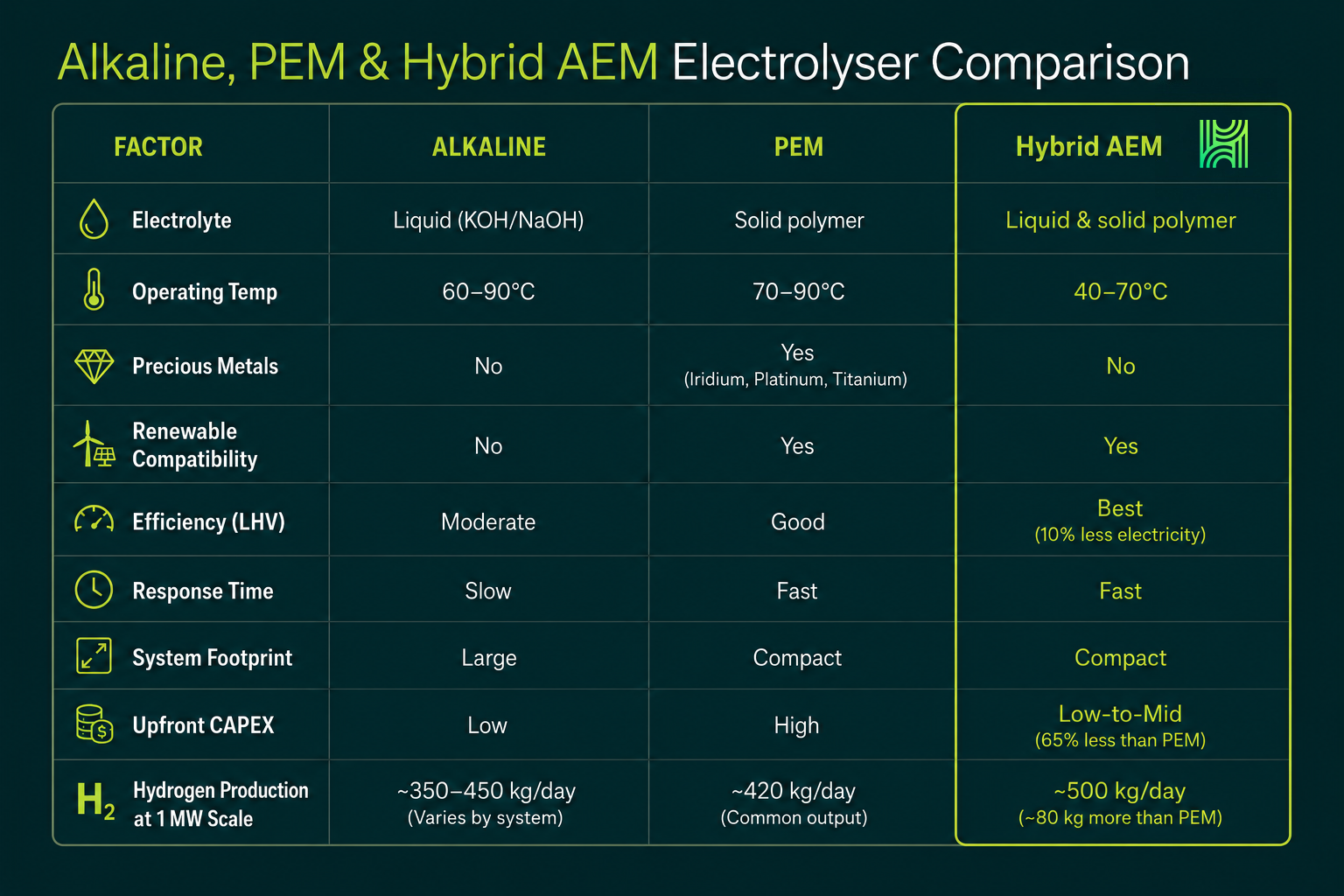
Three technologies dominate the market for refueling station scale (1–5 MW):
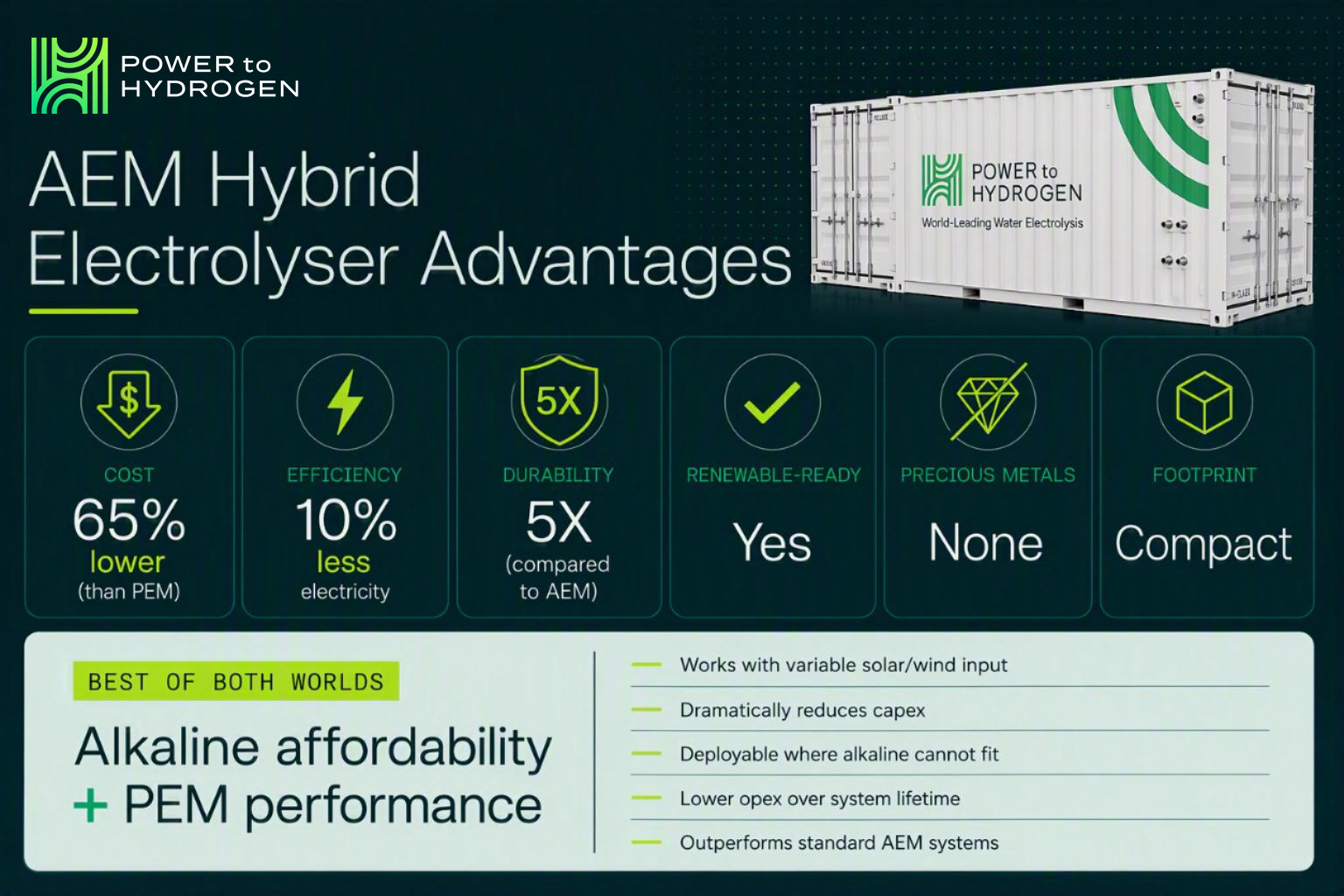
Proton Exchange Membrane (PEM). PEM is compact and efficient, but requires iridium, platinum, and titanium in its construction. These are rare and expensive materials that put a structural floor under capital costs. For many project budgets, PEM simply does not fit. At 1 MW scale, a PEM system commonly produces around 420 kg of hydrogen per day.
Alkaline. Alkaline has lower cost upfront, but requires a steady power supply to operate efficiently. That makes it a poor match for variable renewable inputs and, in most cases, disqualifies it from green hydrogen certification pathways. It also requires additional compression and purification equipment, which means a larger physical footprint. Alkaline is less common in refueling station applications for these reasons, though it remains a competitor in some markets.
Anion Exchange Membrane (AEM). AEM is the emerging category designed to close both gaps. It offers PEM-level efficiency without the precious metals, and the renewable compatibility that alkaline lacks. Newer hybrid AEM designs have also addressed the durability challenges that limited earlier versions of the technology. At 1 MW, a well-performing AEM system can produce around 500 kg per day — approximately 80 kg more than a PEM equivalent, enough to fuel two additional buses per day at that scale.
Conducting an in-depth technology comparison— including total cost of ownership and how to evaluate vendor claims on durability — is crucial to project success. The projects moving forward are the ones where the project team did this comparison with real operating conditions in mind.
Build a refueling station or buy hydrogen?
Not every heavy-duty vehicle refueling station needs to produce its own hydrogen. For very small fleets or early pilots, delivered hydrogen — transported by tube trailer from a central production facility — can be a practical starting point.
The economics shift as volume increases. European research on compressed hydrogen logistics puts truck transport costs between €0.30 and €3.44 per kilogram across distances of 25 to 500 km. Small-volume, mid-distance deliveries, which are typical of refueling station supply chains, sit well above €1/kg. At scale, on-site production becomes the more cost-effective option — and the more resilient one, since it eliminates supply chain dependency.
The break-even point depends on fleet size, location, and electricity cost. Power to Hydrogen can provide a full cost comparison for project developers that want to run the numbers for a specific project.
Where hydrogen refueling projects run into trouble
Even well-resourced, well-intentioned hydrogen projects stall — and they tend to stall for the same reasons:
Offtake that was assumed but never committed.
Technology selected on upfront cost rather than total cost of hydrogen.
Electrolysers spec'd for steady-state operation that degrade under the real-world cycling of a refueling station.
Site selection and technology selection done in separate conversations, with the footprint mismatch discovered after the permitting application.
None of these are unforeseeable. They are foreseeable — and they are avoidable with the right questions asked at the right stage.
What to do before the feasibility study
The projects that move efficiently through development share a common pattern: the hard questions were asked early.
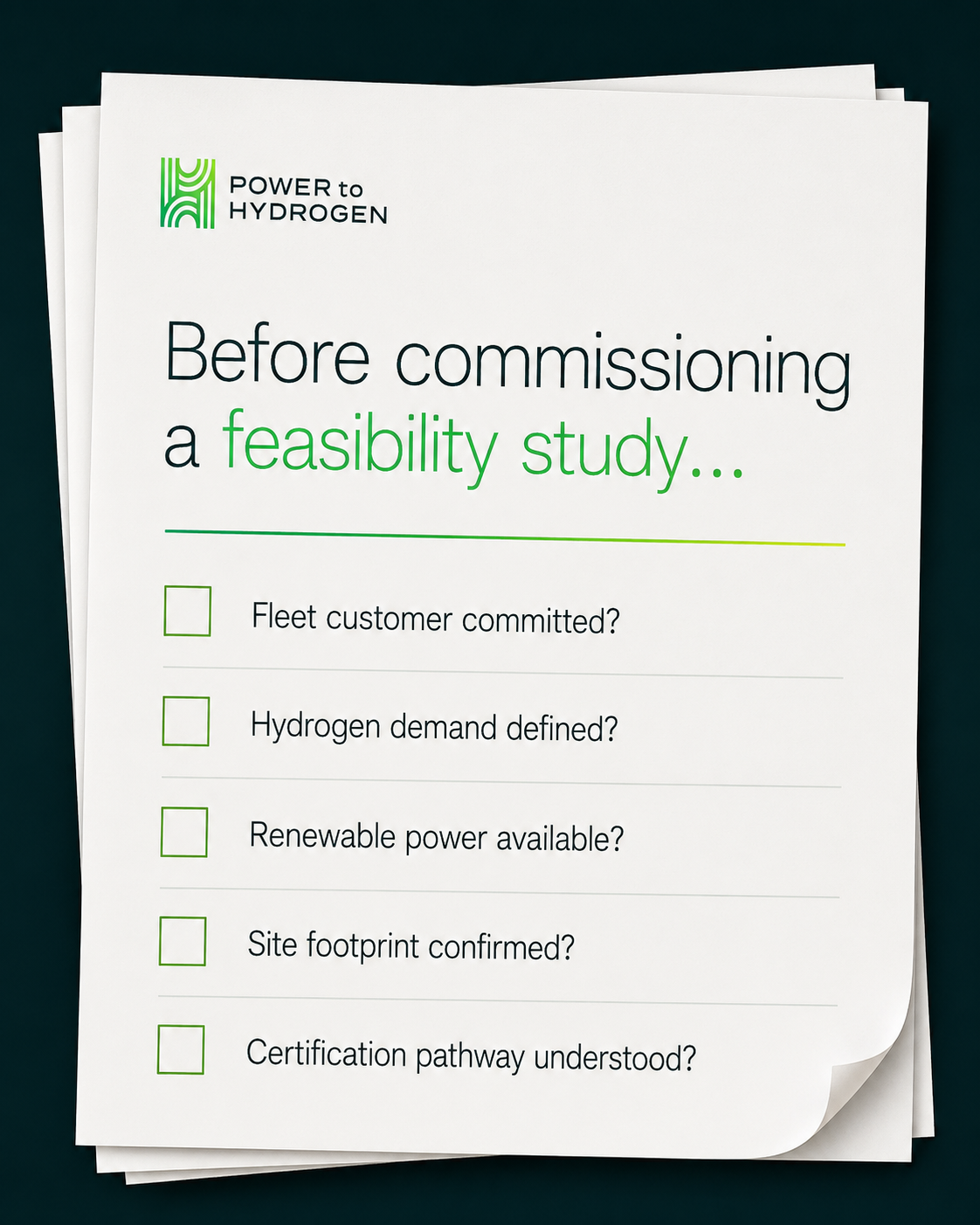
Before commissioning a feasibility study, it's worth having clear answers to five questions:
Who is the fleet customer, and do they have a firm commitment to fuel here?
What is the daily hydrogen demand, and how variable is the refueling schedule?
What renewable power source is available on-site or nearby?
What are the space and setback constraints at the candidate site?
Which green hydrogen certification pathway applies in your country, and what does it require?
The answers to these questions will determine every downstream decision: technology selection, system size, site design and whether the business case closes at all.
Is hydrogen electrolyser technology ready for commercial refueling stations?
For most of the last decade, "does this actually work?" was the first question any serious project developer asked — and a fair one. Early electrolyser deployments at commercial scale were limited, and the gap between what vendors demonstrated in controlled conditions and what performed reliably in the field was real.
That is changing. Commercial-scale deployments are now operational across Europe, generating the kind of performance data that project teams can evaluate against real-world expectations. Durability testing at the stack level has advanced significantly. The question is no longer whether on-site hydrogen production works — it is which technology and which vendor can prove it works at the scale and under the operating conditions your project actually requires.
The vendors who can answer that question with data — not projections, not simulations, but tested performance under variable load and real cycling conditions — are the ones worth shortlisting.
Power to Hydrogen: built for refueling station economics
Power to Hydrogen (P2H2) builds hybrid AEM electrolysers specifically designed for the applications described above: on-site hydrogen production at refueling station scale, paired with renewable energy, under the variable load conditions that real-world operations create.
The technology is built without precious metals, which is what allows it to offer a 65% lower capital cost than PEM while maintaining comparable efficiency. It produces approximately 10% more hydrogen per MW as a result of lower electricity consumption. Durability under cycling conditions is validated through testing, not claimed on a spec sheet.
If you are evaluating technology options for an HDV refueling project or pressure-testing a business case before it goes to your technical team, that’s exactly where the P2H2 team can help.