

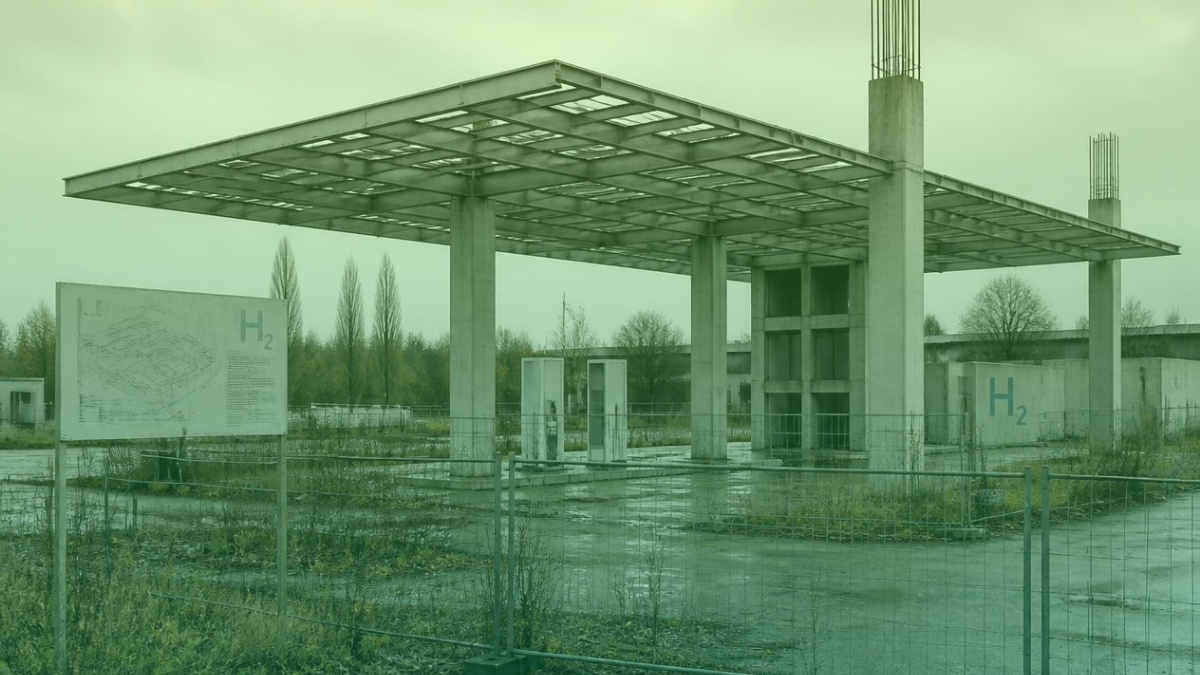
There is a recurring pattern across hydrogen refueling infrastructure projects — particularly those designed to support heavy-duty vehicle fleets.
At the outset, the fundamentals appear sound. The demand is real. Policy incentives are in place. The technical pathway is defined. On paper, the project is viable.
Yet many of these projects do not progress beyond early-stage development.
It is rarely a lack of intent. In most cases, the project developer believes in the project. The fleet customer wants the hydrogen. The grants are applied for. And yet, the project stalls.
So why do so many heavy-duty vehicle hydrogen refueling projects quietly disappear between the feasibility study and the purchase order?
After a decade of conversations across the European hydrogen market, the pattern is consistent enough to be predictable.
Here are the five reasons it keeps happening — and what actually breaking through them looks like.
Proton Exchange Membrane (PEM) electrolysers have been the default technology recommendation for hydrogen refueling stations for a decade. They are compact, efficient, and well-understood by the engineering consultants who write most feasibility studies. On a spec sheet, they look like the obvious choice.
The problem is cost.
PEM electrolysers require rare and expensive materials in their construction: iridium, platinum, titanium. These are not minor line items. They are fundamental to how the technology works. That means the cost ceiling is structural, not something that will be engineered away over the next product generation.
At 1 MW scale — the typical starting point for a bus fleet or light truck corridor — a PEM system comes with a capital expenditure that simply does not survive contact with most project budgets. The project developer runs the levelized cost of hydrogen. It comes back too high. The project gets shelved. The fleet keeps running diesel.
This plays out constantly. Not because hydrogen is unviable for heavy duty transport — it clearly is — but because the cost calculation is being done with the wrong technology in the denominator.
The projects that are moving forward in 2026 are overwhelmingly ones where the project team found a way to get capital cost down without sacrificing performance. That is a technology challenge, not a financing challenge.
Read more: PEM vs. hybrid AEM electrolysers
When on-site production doesn't make sense economically, many project teams fall back on delivered hydrogen as a bridge. Tube trailers. Central production. Scheduled deliveries. It gets the station running without heavy upfront investment. And for very small pilots, it can be the right call.
The problem is that delivered hydrogen is a model that works at the beginning, but breaks at scale.
Transport alone adds roughly €1.10 per kilogram for every 50 kilometers of distance between the production facility and the station. For a fleet operator being charged for that hydrogen, it is a cost that compounds invisibly until it becomes impossible to ignore. Add to that the logistics complexity of scheduling deliveries, the price volatility tied to a production source you do not control, and the supply risk that comes with depending on someone else's infrastructure — and what looks like a practical interim solution often becomes a long-term structural disadvantage.
As the fleet grows and utilization increases, the economics of delivered hydrogen move in the wrong direction. The projects that lock in on-site production early — and select technology that makes it affordable — are the ones that end up with a viable cost-per-kilogram at full capacity. The ones that treat delivery as a permanent answer tend to find that the business case never actually closes.
There is a version of the hydrogen refueling station development process that looks something like this: secure land, design the system, commission the engineering, apply for the grant, issue the RFQ. Somewhere in there, confirm the fleet demand.
That last step should actually be the first. And treating it as a downstream concern is one of the most reliable ways to end up with an empty station and displeased funders.
The fleet customer — whether a city bus operator, a private logistics company, or a waste collection contractor — is not just a user of the station. They are the economic foundation of it. Without a committed offtake agreement, or at minimum a serious Letter of Intent (LOI), the station has no revenue model. Without a revenue model, the project cannot be financed. Without financing, the system never gets ordered.
This is not hypothetical. There are stations in Europe that were built on government grants, opened without a committed fleet, and ran at a fraction of capacity for years before quietly closing. The stations themselves worked. The hydrogen they produced was real. But no one had secured the demand before building the supply.
The projects that succeed treat the fleet operator as a co-developer, not an eventual customer. The conversation about offtake volume, refueling schedule, and hydrogen price happens in month one, not month twenty-four.
Most electrolyser specifications are written for steady-state operation — a system running at a consistent load, producing hydrogen at a predictable rate around the clock. That is the right specification for industrial hydrogen users with flat, continuous demand.
It is almost entirely the wrong specification for a refueling station.
A bus depot might fill twenty buses in a four-hour window in the morning. A truck corridor station might have bursts of heavy demand during driver changeovers, with quiet periods in between. The electrolyser paired with an on-site solar array is going to see significant load variability as cloud cover and time of day affect power availability.
This creates a problem that does not appear on the spec sheet: cycling. Every time an electrolyser starts up, shuts down, ramps up, or ramps down, it puts mechanical and chemical stress on the stack. For most electrolyser technologies, frequent cycling accelerates degradation and shortens the operational lifetime of the system.
The affordable electrolyser technologies — the ones whose capital costs actually survive a real project budget — have historically carried a durability tradeoff under cycling conditions. That gap has been closed by newer hybrid AEM electrolyser designs that maintain the cost advantage without the lifetime penalty. But these are not yet the default option in most feasibility studies, and not every project team knows to look for them.
The question to ask any electrolyser vendor before shortlisting is not just "what is your efficiency?" but "what is your degradation rate under real-world cycling conditions?" and "what testing have you done under variable renewable load?" The answers to those questions will tell you more about total cost of ownership than any spec sheet figure.
Refueling stations are not data centers. They have physical constraints — setback requirements, compression equipment footprints, hydrogen storage volumes — that interact directly with local permitting rules. And those rules vary not just by country but by municipality.
The projects that hit trouble here are almost always the ones where the site selection and technology selection happened in separate conversations. The engineering team chose the technology based on performance. Someone else found the land. When the two came together, the footprint did not fit, the setback did not clear, or the local authority had concerns about the storage volume.
This is fixable, but fixing it late in the process is expensive and demoralizing. It pushes commissioning timelines, burns through contingency budget, and gives procurement teams ammunition to reopen vendor negotiations.
Solving it early means having a clear picture of the system footprint — including compression, cooling, water treatment, and storage, not just the electrolyser itself — before the site is selected, not after.
It also means understanding the difference between alkaline and membrane-based systems on this dimension. Alkaline electrolysers require additional compression and purification equipment that membrane technologies do not, which means a significantly larger installation footprint. For an urban bus depot with limited outdoor space, that difference is not academic.
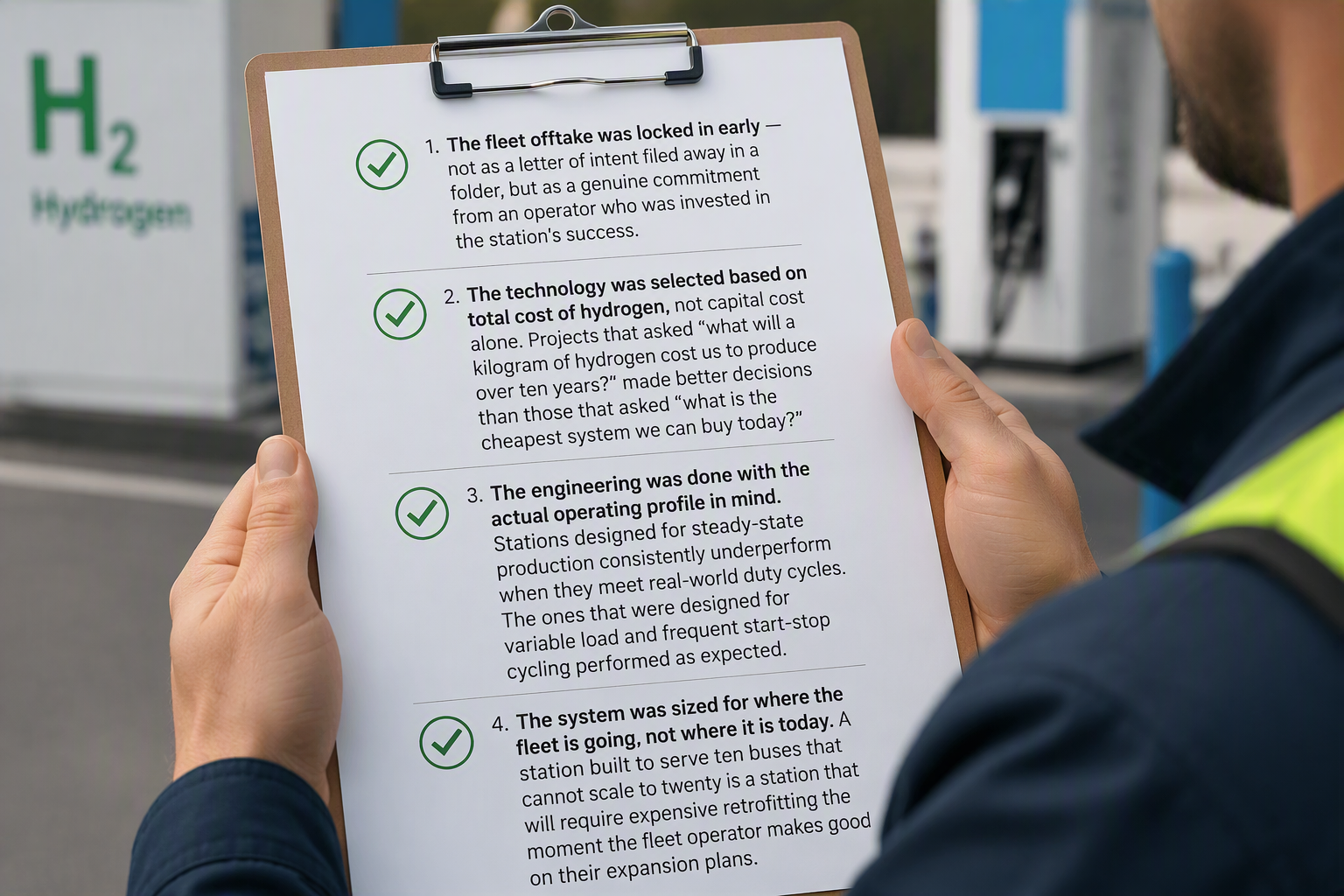
Looking at the refueling station projects that have successfully reached commissioning in the past several years, a few things consistently distinguish them from the ones that stalled:
European clean transport policy is creating a genuine demand signal that did not exist five years ago. Cities are restricting diesel vehicles from urban centers. Logistics operators are under pressure to decarbonize. Bus operators are looking at fleet replacement cycles and asking whether the next generation of vehicles should be battery electric or hydrogen fuel cell.
For long routes and heavy loads, hydrogen increasingly makes operational sense. The projects that are positioned to benefit from this demand are the ones being designed now, with realistic cost assumptions, committed offtake, and technology choices that survive contact with real operating conditions.
The technology that changes the economics exists. The fleet demand is forming. The durability challenges that once made affordable systems risky have been solved. What is left is the willingness to build the business case with different assumptions and the right inputs.
If you are at the stage where those inputs are still being defined — technology shortlist, cost modeling, site assessment — it is worth a conversation before the feasibility study is commissioned. The variables that determine whether a project closes are easier to get right at the beginning than to fix later.


