


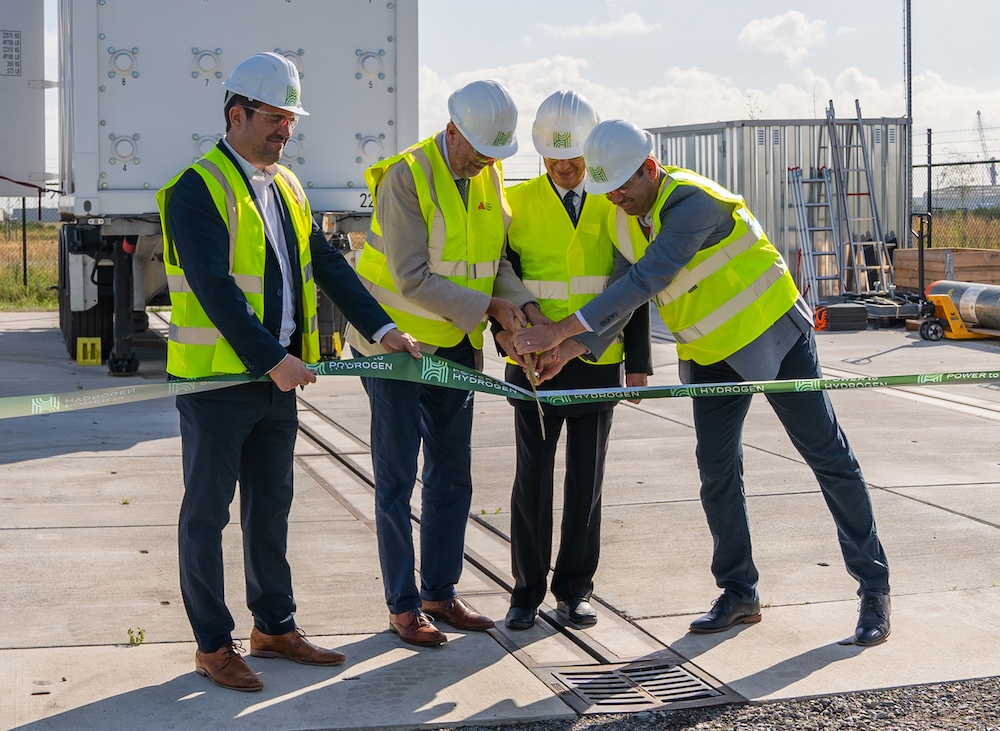
The first system to operate on 250 kW anion exchange membrane (AEM) stacks begins supplying hydrogen to regional customers
ANTWERP, Belgium and COLUMBUS, Ohio — 18 September 2026 — Power to Hydrogen (P2H2), a developer of anion exchange membrane (AEM) electrolyzer systems, today began commercial green hydrogen production at the NextGen District of the Port of Antwerp-Bruges. The 500 kW system, built from two 250 kW stacks and delivered to the site in August, is the first commercial deployment of 250 kW AEM stacks — more than 10x larger than the stacks used in conventional AEM systems, which typically range from 2kW to 25kW.
Now operational, the system will initially produce up to 70 tonnes of green hydrogen per year for regional gas supplier Holthausen and other customers in the area. The hydrogen will be used mainly for mobility customers with other industrial use-cases as an additional potential offtake. Local hydrogen production strengthens European energy resilience and gives the region's fuels, chemicals, and mobility sectors a cost-effective lower-carbon hydrogen supply.
Because electricity is the largest cost in green hydrogen production, P2H2's systems are designed to produce when renewable power is cheapest. The Antwerp system's 10–100% operating range lets it follow Belgium's day-ahead prices, ramping up when power is cheap and ramping down when it is not. As a result, the Antwerp system is able to deliver locally-produced hydrogen that is cost-competitive to other hydrogen sources.
The commissioning comes as P2H2 prepares data from the Antwerp deployment to support a move toward larger platforms, including multi-MW systems. A second commercial order for a 500 kW (dual-250 kW stack) system supporting the EU-funded PYROCO2 green-chemicals project will be delivered to Norwegian research institute SINTEF later this year.
The Antwerp project is supported in part by the European Regional Development Fund (ERDF/EFRO) and the Flemish innovation and entrepreneurship fund administered by VLAIO.
Hybrid AEM Electrolysis: A Durable Pathway For Lower-Cost Green Hydrogen
The deployment is a milestone in moving AEM electrolysis from the laboratory into industrial operation. AEM has long demonstrated PEM-like performance at a cost closer to alkaline, but durability has remained a key barrier. P2H2 has solved the core durability problem.
P2H2's proprietary hybrid AEM-alkaline cell design places an alkaline separator between the membrane and the oxygen-producing electrode, which protects the membrane and extends its life. The system uses low-cost, iridium-free catalysts, a simpler balance of plant than conventional alkaline (including a single electrolyte loop), and mechanical membrane support that enables 30 bar output pressure with minimal hydrogen crossover, cutting downstream compression.
On September 8, P2H2 announced the results of a 1,250-hour pilot with Repsol, one of Europe’s leading energy companies, which measured irreversible degradation of about 2 mV/kHr — 5–10x better than the AEM targets published by the US Department of Energy and the EU Clean Hydrogen Partnership — and projected stack life beyond 50,000 hours. Using Repsol-specific inputs and the U.S. Department of Energy’s H2A-Lite analysis framework, P2H2 projected a levelized cost of hydrogen of approximately €3.86/kg for that pilot, a ~16% reduction versus incumbent electrolyzer technologies.
Paul Matter, CEO, Power to Hydrogen:
"Bringing this system online in one of Europe's most demanding industrial environments is how we answer the skepticism around AEM: not with claims, but with hardware on the ground. Antwerp is the first step in showing that AEM can be real, durable and repeatable, and that it can help bring down the cost of green hydrogen where it matters most."
Carl Holthausen, Director and CTO, Holthausen:
“We have been selling hydrogen long enough to know that the demand for zero-emission hydrogen is real. What continues to hold the market back is access to reliable supply at a price customers can plan around. A dedicated local source gives us the confidence to quote our customers against a known cost and dependable volume, rather than being exposed to changing market conditions.”
Thomas de Béthune, Representative of the European Commission in Belgium:
“Together with the Flemish authorities, we are proud investors in this commercial-scale clean-hydrogen system in the port of Antwerp-Bruges, home to a host of energy-intensive industries in the heart of Europe. Installations like these prove that yes, we can reduce CO2 emissions significantly while making our energy supply more autonomous and secure for our businesses.”
Luk Lemmens, First Deputy, Province of Antwerp:
"To stay competitive, Antwerp's industry needs energy that is reliable, affordable, and clean. The innovative hydrogen system starting operation today shows that it can be produced locally. The Province of Antwerp is proud that it is happening here at our port."
Johan Klaps, President of the Board of Directors, Port of Antwerp-Bruges; Port Alderman of Antwerp:
"NextGen District exists to prove that next-generation clean technologies can work under real industrial conditions, not just in the lab. Power to Hydrogen bringing a commercial-scale electrolyzer online here is exactly the kind of milestone this environment was built to enable, and it strengthens the port's role as a proving ground for Europe's clean industrial transition."
Roel Bosschaerts, NextGen Demo:
"AEM electrolysis is a great example of the future-proof technologies that can deliver real climate impact. Power to Hydrogen's approach — proving the concept at pre-commercial scale before ramping up to full volumes — is exactly what NextGen Demo was built for: derisking and optimising early, so large-scale rollout can happen faster."
About Power to Hydrogen
Power to Hydrogen (P2H2) makes industrial-scale electrolyzer systems that produce green hydrogen from renewable electricity. Its anion exchange membrane (AEM) platform is designed to deliver dynamic performance — including sub-50-millisecond load response and 30 bar hydrogen output — using a lower-cost, iridium-free materials pathway that avoids the scarce inputs that have historically constrained electrolyzers at scale. P2H2’s systems are engineered for direct integration with variable renewable power and are designed to scale to repeatable multi-megawatt deployments, with multiple commercial projects underway globally. P2H2 is backed by AEP, EDP, E.ON, ESB, Air Liquide, JERA and Asahi Kasei, and is a 2026 World Economic Forum Technology Pioneer. To learn more, visit power-h2.com, follow on LinkedIn, or contact info@power-h2.com.
Through the European Fund for Regional Development, the European Union and the Flemish authorities invested close to 900,000 euro in demonstrating the industrial-scale technology that has led to the successful start-up of the Power to Hydrogen production plant in the port of Antwerp-Bruges.


